
By Matthieu Caillaud · Founder, oceanographer
An ensemble forecast does not give one weather scenario; it gives twenty, fifty or more, all plausible. The temptation is to compute an optimal route in each member and look at where they cluster. That is not the decision a skipper or shipowner has to make: at departure, you commit to one plan without knowing which future will occur. We applied a method built around that constraint to an offshore racing case — a virtual Class40 leaving Saint-Malo for Pointe-à-Pitre two days before the Route du Rhum start — and it shows why eyeballing routes is not enough: plans are first eliminated on refusal, then ranked by score.
Correction of 1 November 2026
The first version of this article concluded that the direct exit was the only admissible option. That result came from a defect in our code: the roll calculation evaluated wave slope with the encounter frequency instead of the intrinsic wave frequency, which inflated head-sea roll and flattened following-sea roll. At 14 knots, 3.2 m Hs and 12 s period, head-sea roll drops from 18° to 5.4°. The same plans were replayed under the same forecasts. The figures below are from the corrected run: two plans remain admissible, and the south option is selected at nominal speed, not the direct exit.
The principle: freeze the plans, vary the weather
A plan is an ordered sequence of waypoints, frozen before the comparison. Each plan is replayed across every member of the ensemble by the SeaRoute-Py engine: the geometry stays fixed, while boat speed, waypoint times and encountered conditions vary with the wind, sea state and currents of each member. No plan is re-optimised to exploit the scenario it is tested in — that rule is what keeps the comparison honest, since no one at sea knows which scenario will materialise in advance.
Four candidate plans were frozen, and their waypoints archived with a checksum, before computation:
- Weather reference: route computed on the deterministic forecast.
- North option and south option: alternatives derived from previously computed routes.
- Direct exit: shared English Channel exit with the reference up to roughly 49.14° N, 6.22° W, then heading for Pointe-à-Pitre.
The direct exit is the simplest baseline. It is included on purpose: picking a winner among hand-crafted detours proves nothing unless the obvious baseline is evaluated under the same conditions. Here it remains admissible without being selected — which is information in its own right.
Setup
- Vessel
- Virtual Class40, approximate uncalibrated polar, no engine and no real competitors
- Course
- Simulated departure from Saint-Malo on 1 November 2026 at 12:02 UTC, target Pointe-à-Pitre, 23 modelled exclusion zones
- Horizon
- 72 h, evaluated on remaining distance to Guadeloupe
- Scenarios
- 10 ECMWF ENS members and 10 NOAA GEFS members, 29 October 2026 00 UTC runs
- Currents
- CMEMS, identical across both families
- Sensitivity
- Polar at −10 %, nominal and +10 %, giving 240 evaluations in total
- Rules frozen beforehand
- Admissibility criterion, scoring rule, 900 s compute budget
Step 1: discard plans that fail
A plan is admissible if it completes 72 full hours across all twenty scenarios while respecting the polar, exclusion zones and the model’s seakeeping limits. A refusal is never turned into zero time or an invented arrival: it stays visible.
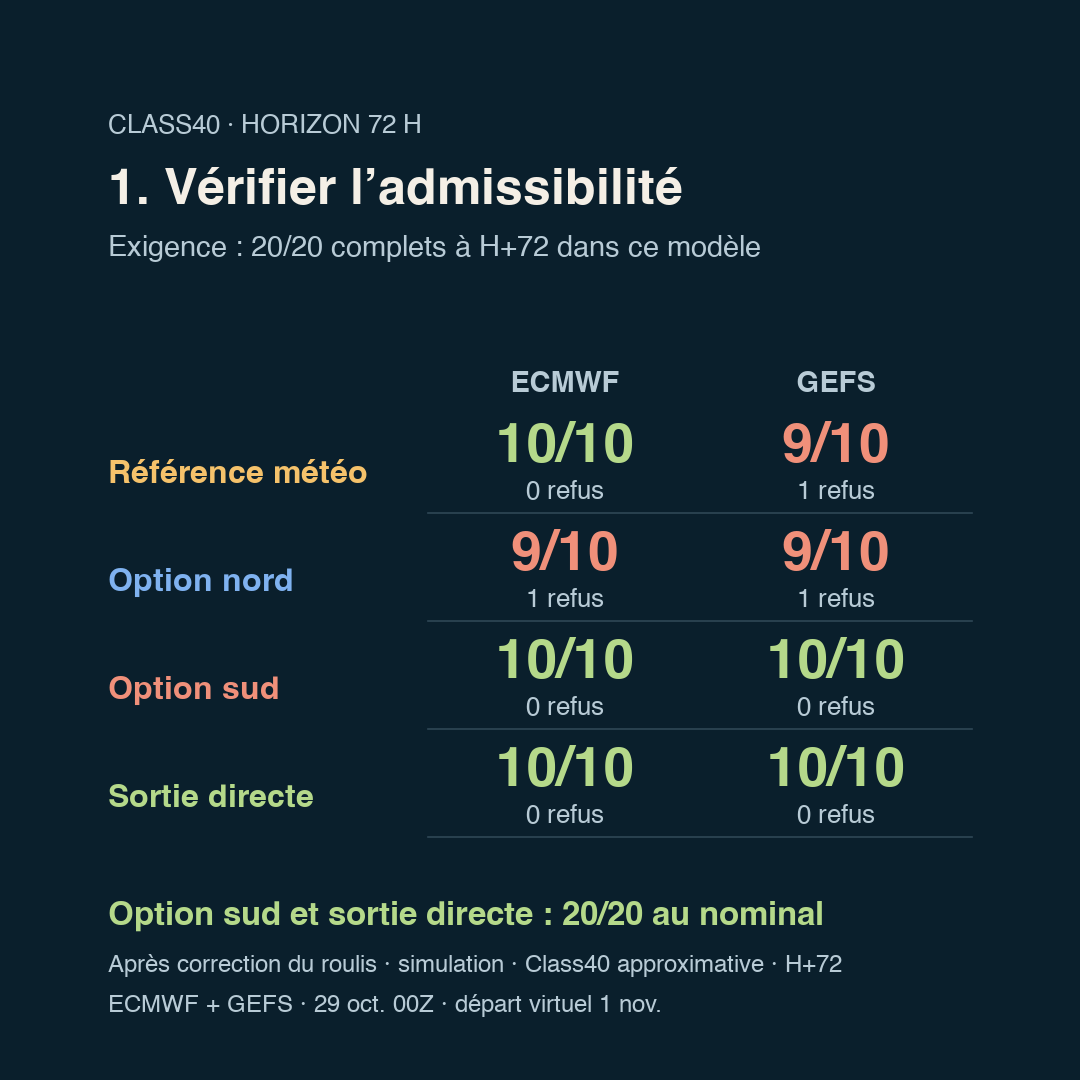
- Weather reference
- ECMWF 10/10, GEFS 9/10 — not admissible
- North option
- ECMWF 9/10, GEFS 9/10 — not admissible
- South option
- ECMWF 10/10, GEFS 10/10 — admissible
- Direct exit
- ECMWF 10/10, GEFS 10/10 — admissible
Reading each family separately is instructive. Under ECMWF alone, three plans out of four pass; GEFS is what eliminates the reference. An analysis based on ECMWF alone would have kept three finalists. Those three nominal refusals are stops due to zero propulsion in the model, not seakeeping refusals.
Step 2: rank on adverse cases
Among admissible plans, the score measures the distance remaining at H+72. For each family, it weights equally the mean remaining distance and the mean of the two worst scenarios; the retained score is that of the less favourable family. A plan that performs well on average but collapses in two scenarios is penalised. The twenty members are not merged into a single probability: ECMWF and GEFS are not jointly calibrated, and their disagreements are information in themselves.
Two options clear step 1. The south option scores 2,706.2 nautical miles and the direct exit 2,711.0 nautical miles, a 4.8-mile margin — these are composite scores, not distances along a single trajectory. The south option is selected by a modest margin. The score also exposes a disagreement: under ECMWF alone, the weather reference achieves the best score (2,629.0 nm), but a single GEFS refusal eliminates it.
Step 3: stress-test the polar
The polar of a virtual vessel is an assumption. The same plans were replayed with speeds scaled down and up by 10 %. At −10 %, the reference, south option and direct exit are all admissible, and the reference is selected. At +10 %, only the south option remains admissible: one ECMWF member stops the direct exit through lack of propulsion. The selected plan therefore depends on that performance assumption.
Out of 240 evaluations, 231 complete and 9 are preserved physical refusals, with no missing data, budget overrun or software failure. The conclusion fits in one sentence: the south option is selected at nominal speed in this simulation, the choice is sensitive to the polar and must be confirmed with the vessel’s own polar.
What the method caught along the way
Two errors would have distorted the comparison if left unchecked. An initial run rejected all 240 cases: the comparator was applying comfort limits whereas the plans had been built with structural limits. That run was kept as a diagnostic, the configuration aligned, and the plans, data and scoring rule left untouched. In an earlier trial, a south option crossed an exclusion zone near Ushant even though every waypoint was valid: only a continuous segment check exposed it. The roll defect, by contrast, slipped past those checks and was published — see the correction at the top of this article.
Key takeaways for ensemble weather routing
- Freeze candidate plans before inspecting ensemble members, and never re-optimise them inside the evaluated scenario.
- Include the simplest baseline in the comparison, even if it is not selected.
- Check admissibility before ranking, and keep refusals visible.
- Rank with a score that weights adverse tail cases, not the mean alone.
- Use two model families without blending them, and read their disagreements.
- Test sensitivity to vessel performance assumptions.
- Date the result: it applies to one forecast run and must be recomputed on the next.
This method builds on an earlier finding: on a cargo passage between Brest and Ponta Delgada, the ECMWF ensemble improved arrival-time accuracy over a single forecast, yet the route derived from it did not beat a direct route (see the corresponding article). Replaying frozen plans is how an ensemble is put to work for route selection.
Limits
The vessel is virtual: approximate polar, seakeeping limits not qualified for a real Class40, simplified wave response. The corrected roll calculation remains generic and uncalibrated. The model evaluates the polar from the course over ground before current correction. Daily CMEMS currents do not resolve tidal currents in the Bay of Saint-Malo: this is a strategic study and does not cover coastal start navigation. The result covers only the first 72 hours, with no transatlantic ETA or calibrated success probability, and has not been compared against observations. No competitor positions are used. This is a decision-support tool, not a navigation instruction.
Sources and references
The metrics, comparisons and maps specific to this article are OceanData Consulting results and calculations; the links below document the datasets, standards and publications used.
Facing a similar modeling or metocean data challenge?
From physical model calibration to operational AI post-processing, we help turn marine observations into validated, decision-ready forecasts.
Frequently asked questions
How do you use an ensemble forecast to choose a route?
By freezing a few candidate plans first — including the simplest baseline — then replaying each plan across every ensemble scenario without re-optimising it. Plans that fail in any scenario are discarded, and the remaining plans are ranked using a score that weights adverse cases. On a virtual Class40 from Saint-Malo to Pointe-à-Pitre, four plans were replayed across ten ECMWF ENS and ten NOAA GEFS members from 29 October 2026 at a 72-hour horizon.
Why not compute an optimal route for each ensemble member?
Because each optimal route would be tailored to a single future that the navigator does not know: ten optimal routes describe weather spread, not the decision to commit to at departure. What you decide at the start is one plan, so it must be evaluated across all plausible futures at once, with fixed geometry and scenario-dependent speeds.
What does the Route du Rhum simulation conclude?
After fixing a roll-calculation defect on 1 November 2026, two plans complete 72 hours across all twenty scenarios at nominal speed: the south option, selected with a 4.8-mile score lead, and the direct exit. The ten ECMWF scenarios alone favour the reference route. The selected plan changes with the polar: reference at −10 %, south option alone admissible at +10 %. The result does not tell which plan is better at sea and must be confirmed with the vessel’s own polar.