
By Matthieu Caillaud · Founder, oceanographer
"How long will you wait for a weather window to lay this cable in the English Channel, and does that number hold up in front of a Marine Warranty Surveyor?" That is the question every insurability case for a lay operation has to answer. Here we answer it for a corridor running Ushant → Casquets → Dover Strait, using DNV-ST-N001 vocabulary — operability, OPLIM, alpha factor, restricted and non-restricted regimes — at the general-framework level, without citing clause numbers.
What 'operability' means here
A lay corridor's operability is the fraction of time sea state stays below the operational limit (OPLIM) set for the vessel and manoeuvre in question. Over the ERA5 2023 reference year, this corridor shows a monthly average operability of 69.8%. The associated weather-window statistic, at the 90th percentile, is 142 h: the continuous window duration you can expect with 90% confidence over the period considered.
Those two numbers alone are not enough to defend a schedule in front of an underwriter. An MWS does not just ask "how much time is available" — they ask "under what threshold assumption, on what statistical basis, and what actually closes the window." The next three sections answer those three questions.
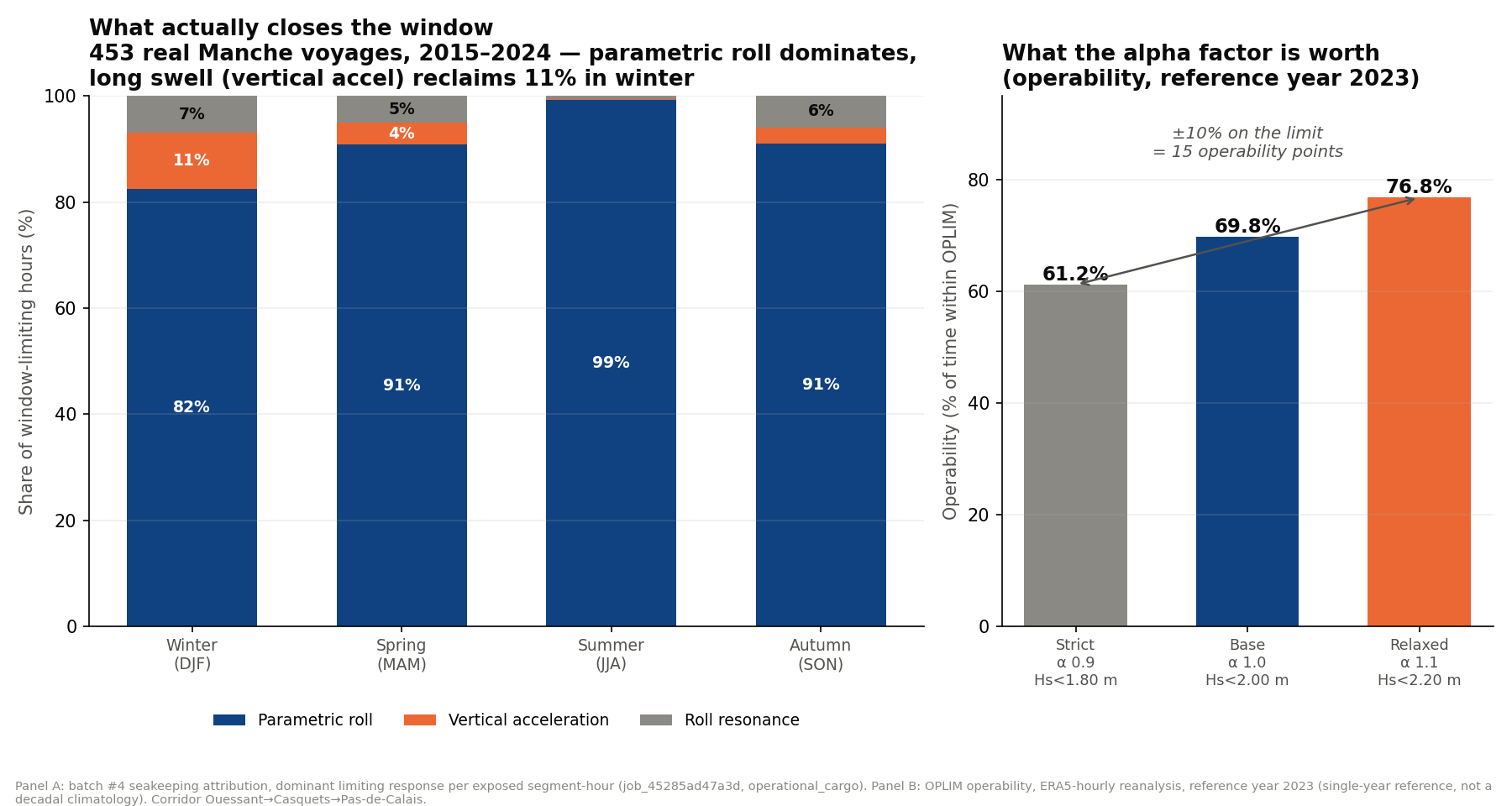
Sensitivity to the OPLIM threshold: ±10% on the threshold, ±15 points of operability
The OPLIM threshold is never a fixed constant: it depends on vessel response, configuration, and the margins set by the operator or the MWS. We therefore tested operability's sensitivity to this threshold, holding corridor and year constant:
- Threshold −10%
- Operability 61.2%
- Baseline threshold
- Operability 69.8%
- Threshold +10%
- Operability 76.8%
In other words, a ±10% shift in the threshold moves operability by roughly ±15 points. That is the order of magnitude separating a tight schedule from a comfortable one, and it is exactly what an alpha factor — in the DNV-ST-N001 sense, the margin applied between the weather-restricted regime (less than 72 h of reliable forecast) and the non-restricted regime — is meant to absorb. Documenting this sensitivity, rather than presenting a single operability figure as a fixed truth, is what lets you negotiate the chosen threshold with a surveyor instead of simply accepting it.
What actually closes the window: beyond the 'Hs 2 m' reflex
Most operability studies stop at a single criterion: "no installation above Hs 2 m." That is a convenient proxy, not an explanation. Wave height alone says nothing about which vessel response mode actually interrupts the operation — and that mode changes with the season.
Across 453 real cargo voyages on the corridor (2015–2024, multi-annual basis), we attributed the limiting response mode for every interruption:
- Parametric roll
- 90.7% of interruptions over the full period — 99.2% in summer, 82.5% in winter.
- Vertical acceleration
- 4.7% on annual average, but 10.6% in winter, driven by the return of long-period swell.
- Roll resonance
- 4.7% on annual average.
The result that matters for an insurability case is this: in summer, the window closes almost always because of parametric roll, a mode that depends far more on wave period and vessel geometry than on height alone. In winter, long-period swell pushes the share of vertical acceleration events to more than double its annual average. Naming the limiting mode, season by season, is what lets you negotiate a margin with an MWS — a "Hs 2 m" proxy does not, because it hides the actual cause behind a single threshold.
Reliability of the input wave data
An operability figure is only defensible if the wave data feeding it is too. We validate the wave fields against satellite altimetry:
- ERA5
- n = 47,988 comparison points. Bias −0.083 m, RMSE 0.3 m, scatter index (SI) 17.5%.
- MFWAM
- Bias +0.020 m, scatter index (SI) 11.3%.
MFWAM shows lower scatter and a near-zero bias, making it the better source for short-term calculation. ERA5 keeps a moderate negative bias and wider scatter, consistent with its resolution: an acceptable trade-off for a full-year statistical analysis, less so for an operational forecast a few days out.
What these numbers do not say — and the next step
Being precise about the scope of these results is what makes them defensible rather than sellable. The 69.8% operability and the 142 h window statistic rest on ERA5 2023, a single reference year — not a climatology. Only the closure-criterion attribution is multi-annual (2015–2024, across the 453 real voyages).
A non-restricted-regime argument in front of an MWS — that is, a forecast beyond 72 h judged reliable enough to commit the operation without a reinforced safety margin — requires extending to a multi-annual ERA5. That is the announced next step for this corridor, not an already-established result.
It is also worth distinguishing two kinds of result: a non-blocking seakeeping statistic is an occurrence statistic — it says how often a response mode stays under threshold — not an operational safety validation, which requires a dedicated seakeeping study, vessel by vessel, in front of the MWS.
Preparing an operability case for a cable, umbilical, or pipeline lay in the Channel or elsewhere? Discover the Cable Corridor Atlas offer, or read the full sediment mobility atlas methodology that complements this operability analysis for burial design.
Sources and references
The metrics, comparisons and maps specific to this article are OceanData Consulting results and calculations; the links below document the datasets, standards and publications used.
Facing a similar modeling or metocean data challenge?
From physical model calibration to operational AI post-processing, we help turn marine observations into validated, decision-ready forecasts.
Frequently asked questions
What is the operability of a cable-lay corridor?
It is the fraction of time sea state stays below the operational limit (OPLIM) set for the vessel and manoeuvre in question. On the Ushant — Casquets — Dover Strait corridor over the ERA5 2023 reference year, it is 69.8% as a monthly average, with a continuous-window statistic of 142 h at the 90th percentile.
How sensitive is operability to the chosen OPLIM threshold?
A ±10% shift in the threshold moves operability by roughly ±15 points: 61.2% at −10%, 69.8% at the baseline threshold, 76.8% at +10%, holding corridor and year constant. That is exactly the magnitude an alpha factor is meant to absorb.
Is an "Hs 2 m" criterion enough to describe a lay window?
No. Across 453 real transits of the corridor (2015-2024), parametric roll accounts for 90.7% of interruptions — 99.2% in summer, 82.5% in winter — a mode driven by wave period and vessel geometry far more than by wave height alone. In winter, long-period swell raises vertical accelerations to 10.6%, against 4.7% as an annual average.